Showing posts with label asterisk. Show all posts

Monday, October 1, 2018

Astricon 2018

Astricon 2018, the Asterisk users’ conference, is just several days away. It takes place again in Orlando, FL, USA, during October 9-11, 2018.
Kamailio is very well represented at this edition, besides having a stand in the expo floor, there will be presentations by Alex Balashov, Daniel-Constantin Mierla and Fred Posner.
You can find the schedule and more details about the event at:
We hope to see many of you in Orlando!
Thanks for flying Kamailio!

Friday, March 9, 2018

Kamailio At Asterisk Africa Conference 2018

Alex Balashov from Evariste Systems, one of our Kamailio management team members, went the long route from Atlanta, USA, to Johannesburg, South Africa, to participate at Asterisk Community Conference Africa 2018, event happening during March 14-15.
He is presenting two sessions:
The event is promoting Asterisk and open source VoIP technologies, with a selected group of local speakers and invited international guest, besides Alex, one can meet there with  Matt Fredrikson (project lead of Asterisk), David Duffett (community manager of Asterisk) or Lorenzo Emilitri (QueueMetrics) and interact via remote video participation with Allison Smith (the Asterisk IVR voice) and Dan Jenkins (CommCon UK).
Should you be in the area and working with real time communications, try not to miss this conference. Catch Alex around and get more familiar with Kamailio and the latest project updates!
Also do not forget about the next Kamailio World Conference, May 14-16, 2018, in Berlin, Germany! Alex will be there as well, the details for most of the sessions are published. Still few weeks for early registration price, however, be aware that the number of seats are limited, at the past editions we were fully booked. Do not delay the registration in order to secure your participation!
Thanks for flying Kamailio!

Wednesday, October 18, 2017

AstriCon 2017 Remarks

The 2017 edition of AstriCon was very intense, or at least it was for me (Daniel-Constantin Mierla, Asipto) and the Kamailio presence at the event. Three days without any time to rest!
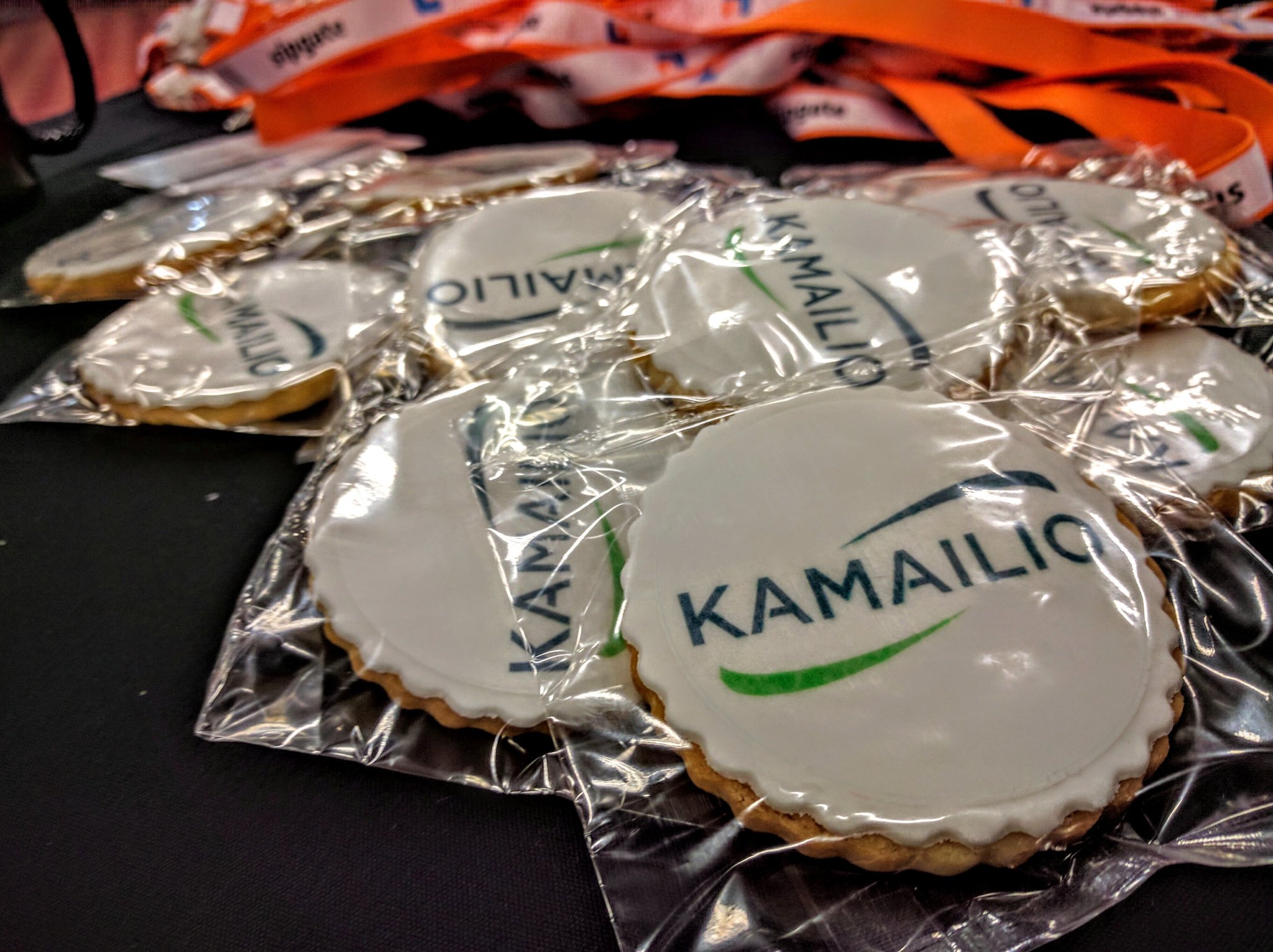
Before summarising the event from personal perspective, I want to give credits to the people that helped at Kamailio booth and around. Big thanks to Fred Posner (The Palner GroupLOD), he did the heavy lifting on all booth logistics, from preparing required things in advance, setting up the space, banners and rollups, stickers, a.s.o. Of course, Yeni from DreamDayCakes baked again the famous Kamailio and Asterisk cookies, very delicious bits that people could taste at our booth.
Carsten Bock from NG-Voice was there with his Kamailio-VoLTE demos and devices. Torrey Searle’s giveaways from Voxbone were very popular again. Alex Balashov from Evariste Systems ensured that anyone in doubt understands properly the role of Kamailio in a VoIP network and the benefits of using it along with PBX systems. Joran Vinzens from Sipgate completed our team, being around as we needed.
It was a great time to catch up with many friends, VoIP projects and companies in the expo area, sharing the space with Dan Bogos from CGRateS project, chatting with the guys from Obihai, IssabelPBX, FreeSwitch, Janus WebRTC Gateway, Simwood, Bicom, Homer Sipcapture, Telnyx, Greenfield…
There were four presentations by the people at the booth — I, Carsten, Fred and Joran had talks on Wednesday or Thursday. On Tuesday, I, Fred and Torrey participated to AstriDevCon, as always a very good full day session with technical debates, with Mathew Friedrikson and Matt Jordan coordinating and talking about what’s expected next in Asterisk.
Close to the end of the event on Thursday, it was the open source project management panel, with me among the panelists. Being completely warmed up and with some pressure from James Body, I also did the Dangerous Demos, where the Ubuntu Phone decided to reboot as I was on stage, leading me towards the Riskiest Demo Prize (aka Crash & Burn). Carsten and Torrey did dangerous demos as well, with Carsten being the runner up on one of the tracks, which secured him a nice prize as well.
Kamailio related presentations will be collected at:
I expect that recordings of the sessions will become available in the near future from the organizers of Astricon.
During the breaks and evenings, I enjoyed amazing time with friends and kamailians around the world. It’s no time to bore with people such as James Body, Simon Woodhead, Susanne Bowen, David Duffett, Nir Simionovich, Lorenzo Miniero … and many others that I miss to remember at this moment…
Definitely it was one of the best AstriCon ever, credits to Digium and the organizing team! Kamailio had a great time there, see you at the next editions!
Thanks for flying Kamailio!

Friday, September 22, 2017

AstriCon 2017

Kamailio is going to be present at AstriCon 2017, the Asterisk User Conference and Exhibition organized by Digium, to take place in Orlando, FL, USA, during October 3-5, 2017.
Carsten BockDaniel-Constantin MierlaFred Posner and Jöran Vinzens will have presentations about Kamailio (see the schedule here). Besides the conference sessions, Kamailio project has a booth the expo area, be sure you stop by for a chat and some cool demos of using Kamailio alone or together with Asterisk.
We expect a consistent group of people from the Kamailio community, the event being a great chance to meet with many world wide friends, especially the North American kamailians.
Looking forward to meeting many of you in Orlando by beginning of October!
Thanks for flying Kamailio!

Monday, July 10, 2017

IvozProvider: Kamailio And Asterisk Based VoIP System

IvozProvider is a provider oriented multilevel IP telephony solution for use on public internet or private networks. It allows multiple access levels within the same infrastructure, from operator administrator to granular brand and company administrators as well as end user.
Here is an excerpt from its presentation:
“IvozProvider was designed always keeping in mind the horizontal scaling of each of its elements, so it can handle hundred of thousands concurrent calls and what is more important, adapt the platform resources to the expected service quality.”
It relies on an handful of open source applications, including Kamailio, RTPEngine, Asterisk, MySQL or JsSIP.
The project is available on Github at:
It has quite an extensive documentation online, offering several options for an easy install:
It is developed by Irontec, the company being another popular SIP-related project, respectively sngrep.

Friday, September 16, 2016

AstriCon 2016

The Asterisk Users Conference – AstriCon – is taking place in Glendale, Arizona, during September 27-29, 2016.
astricon-logo
With a consistent group of VoIP community using both Kamailio and Asterisk projects, Kamailio will have again a strong presence on site this year, including the participation in the expo floor, coordinated this edition by Fred Posner.
Along with him, you may meet around Torrey Searle, Nir Simionovich, Joran Vinzens and others that can answer your questions about Kamailio and Asterisk. Like in the past editions, several presentations will touch the use of Kamailio and integration with Asterisk — see agenda.
It is definitely a must-attend event if you are looking to build flexible real time communications using Kamailio and Asterisk, or even beyond that, there are not many places around the world where you can find so much VoIP knowledge at the same time along the year!

Friday, September 18, 2015

Astricon, Oct 13-15, 2015, in Orlando

Time for another Astricon, the Asterisk Users Conference, is approaching.
Kamailio project will be present at the event, with an exhibition booth as well as talks about SIP, Kamailio and Asterisk, by Fred Posner and I. Many other developers and community members will be at the event, such as Torrey Searle, Alex Balashov, Nir Simionovich or JR Richardson, therefore it looks like a great place to come and meet other Kamailians.
Astricon is the event where a lot of Asterisk and Kamailio knowledge is concentrated in the same place, if you need to learn more about one or the other and how to combine them, then this event is the right opportunity. More about the event can be found at:
If you offer services or products that incorporate Kamailio, you are welcome to join our booth in the exhibition area, you can bring flyers, giveaways as well as come with a demo to show on site. Contact us via mailing list .

Monday, April 27, 2015

Kamailio World 2015 – The Schedule

It is one month till the start of Kamailio World 2015, time has passed very fast since we announced the event, accelerated by April filled with many public holidays.
The first draft of the schedule is now available, as usual, expect many speakers to tune the content of their presentation along the way to the day of the talk, to surprise the audience with challenging concepts and visions.
speaker-view
At this edition we were pleasely surprised by the number of submissions, but it was an extremely hard task to select the sessions. To accommodate as much as possible, we are introducing the lightning talks, two of 10 minutes each, to give the opportunity to present shortly about interesting ideas or updates of applications used in Kamailio and VoIP eco-system.
The two days of conference are filled with 28 sessions, the event being completed with 5 technical workshopsduring the pre-conference day. Several exhibitors will be available during the conference days with showcases of their products or solutions, ready with many demos on site.
We are very grateful to our sponsors, which made possible to bring again a consistent number of speakers, ensuring first class quality content for the entire event.
In about 4 weeks, we will be ready to welcome you in the beautiful city center of Berlin. Don’t miss the opportunity to attend this event, it is unique across Europe, bringing open source and real time communications industry together, bridging flexibility innovation with telecommunication businesses. It is now the right time to register!
See you in Berlin at the end of May!

Tuesday, September 30, 2014

Astricon 2014

Kamailio is going to have a rich presence at Astricon 2014, Oct 22-14, 2014, in Las Vegas, USA – the event focusing on Asterisk and the eco-system around it.
With a close collaboration between the two open source projects, starting from early 2000 years, expect high quality talks approaching how-to and use case tutorials about combining Asterisk and Kamailio to build, secure, scalable and innovative real time communication systems and services.
Daniel-Constantin Mierla, Peter Dunkley and Giaccomo Vacca from Kamailio community will give presentations and are ready to meet on site and discuss with everyone interested in learning more about Kamailio and how to integrate it with Asterisk.
Looking forward to meeting you in Vegas!

Wednesday, September 25, 2013

Kamailio at Astricon

Kamailio project will be present at Astricon with a stand in the exhibition area. Stop by the booth #19 to chat with us or see some demos from various companies using Kamailio – among the people at the booth you can find:
The conference schedule include several talks related to Kamailio, don’t miss them!
Overall, if you are a user of Asterisk and Kamailio, Astricon is an event that you must attend.
We look forward to meeting you in Atlanta!

Monday, August 26, 2013

Astricon 2013 – The 10 years celebration

Astricon, the Asterisk conference, celebrates big this year with its tenth edition, event to take place in Atlanta, GA, USA, during October 8-10, 2013. Using Kamailio and Asterisk is something very common, therefore our presence at the show is going to be very consistent.
  • Daniel-Constantin Mierla, co-founder of Kamailio project
  • Klaus Darilion, member of Kamailio management board
  • Olle E. Johansson, main contributor of SIP channel in Asterisk and co-founder of Astricon
  • Peter Dunkley, main author of WebSocket support for WebRTC in Kamailio
Other developers, friends and community members of Kamailio will be around, among them JR Richardson, Nir Simionovich, Eric Klein (all three taking care of Kamailio presence at last year edition), Alex Balashov, Fred Posner, James Body, Randy Resnick.
With a set of very interesting parallel tracks, we want to make sure you will be able to learn as much as possible about Kamailio and Asterisk, on topics such as scalability, security or rich communication services. We are eager to talk to you, thus you can contact us on mailing lists (user or devel communities) at any time to get in touch. You will find some of us in the exhibition area as well during the event.
Considering that next Asterisk release comes with a refactored SIP channel and based on quick check of the agenda, it is obvious that the event is full of novelty content you don’t want to miss. No matter you are new to Kamailio or new to Asterisk, this is the right event to attend for starting to use the two together.
Looking forward to meeting many of you in Atlanta!

Friday, March 23, 2012

ITSPA Awards 2012 – Open Source VoIP Projects

ITSPA UK has unveiled the winners of its 4th annual Awards, an event designed to celebrate innovation and best practice in the VoIP industry.
The event took place at the House of Commons Members Dining Room, Palace of Westminster, London, on 21st of March 2012, hosted by Dr Julian Huppert MP, Vice Chair of the Parliamentary Internet Communications and Technology Forum.

With main focus on awarding IP Telephony businesses in UK, this year they introduced a new category, “Members’ Pick Award”, to endorse something or someone that has provided real value to VoIP Industry. Open Source VoIP Projects as a group was introduced in this category, made it do the final and ultimately won the category.

I (Daniel-Constantin Mierla, as co-founder and member of management board of Kamailio SIP Server project) attended the event and was selected to pick up the award.

The members of ITSPA acknowledged the major role of open source VoIP projects for their businesses, many of them would have not existed without these projects. Awarding Open Source VoIP Projects as a group was decided because most of the deployments combine several projects to build a complete IP telephony platform. It is a common practice to mix applications such as Kamailio/SER, Asterisk or FreeSwitch to build large VoIP systems and provide a broader range of services.
It is yet another confirmation of reliability and quality solutions provided by Open Source environment for real time communications.

This is also an opportunity to send best wishes and regards to all the people behind Open Source VoIP Projects, developers or community members, that dedicate work and time to develop and improve the quality of the applications and act in the true spirit of Open Source: freedom and fairness!

Tuesday, June 7, 2011

A look at SIP:Provider CE v2.2

SIP:Provider Community Edition (SPCE) has recently released the version 2.2. The out-of-the-box VoIP service operating platform added in this version a lot of interesting new stuff.

First is about the upgrade of the operating system to Debian Squeeze. Also Kamailio SIP Server and SIP Express Media Server (SEMS) are integrated with their latest stable branches.

From this point of view, having the latest Kamailio opens the doors to add by yourself any of its features in version 3.1.x directly in the configuration file, such as SIP/SIMPLE presence or secure communication over TLS.

In terms of architecture, the platform was re-sketched from grounds. It runs an instance of Kamailio to guard the other SIP applications, namely the SIP registrar and proxy (another Kamailio instance), the voicemail server (Asterisk) and the back-to-back user agent (SEMS). Besides the role of entry and exit point in the platform, the first instance of Kamailio acts as a load balancer, meaning, for example, that you can add new SIP proxy/registrar servers as you need.

Talking about security, only the Kamailio load balancer is running on public IP, all the rests can run on an internal one, for example 127.0.0.1, making impossible to be accessed from outside, avoiding DoS attacks on them. The load balancer is not using any SQL database, thus is able to absorb impressive amount of SIP traffic, being easy to deal with any kind of attacks. In addition, all the calls are routed through SEMS for SIP signaling topology hiding, protecting the coordinates of core components and the end points.

Caring about security had high priority in this SPCE release, besides those listed above, there are configurable options to protect against scanning and flooding attacks.

A brand new component of the platform is the ngcp-mediaproxy-ng (some notes about it here) which replaces RTPProxy for NAT traversal. The main benefits are in terms of QoS, ngcp-mediaproxy-ng using a kernel module to relay the media packets. The application has been developed in-house, used for many years in production and now released open source under GPLv3 for SPCE.

The web interface got also some fresh air, in particular the administration portal makes more use of web2.0 technologies, improving the user experience.

I am migrating one of the public VoIP services that run Kamailio to SPCE -- then it would be easy to try & feel it quickly. The plan is to go beyond the standard distribution, very likely will have SIP presence and few more features - the targets to be included in the new version of SPCE.

If you want to give it a try by yourself, choose between the APT repository or one of the provided virtual machines images for VMWare of VirtualBox, see details at:
Stay tuned for more updates!

Wednesday, June 1, 2011

The race to the new and world wide telco

Globalization is everywhere. Still one of the most crumbled markets is the telecom world (classic telephony or mobile). But we are tired of changing SIM cards as we land, we are tired of remembering to redirect numbers when we leave the office, we are tired to memorize all our phone numbers, someone's gonna fix it ... lots of money still there and the seat of a world wide telco is yet free.

The race (could be called war as well) started: Apple, Facebook, Google and Microsoft moved troops, stroke and changed the strategies. We know who is top search engine, top gadget maker, top social networking platform or top operating system vendor, but who is going to win the top world-wide telco crown? Time will decide, first for now just a quick look at top fighters.

Microsoft

Being still hot, let's look first at Microsoft and its acquisition Skype.

Deal was agreed, but it is going to take some time to get approved by authorities. This period is a big waste of time. Besides that, the whole eco-system is a mixture, fitting pieces (i.e., Microsoft applications with Skype communication) together to build a puzzle that was not designed for this goal from the beginning it is going to cost more time and quite some money in development and deployment.

Another weak point for this team is poor presence among end user mobile terminals. Windows 7 for mobiles is at its very young age, iOS and Android have far more third addons that significantly balance the end user decisions of what to buy. Moreover Microsoft does not have a branded hardware yet that attracts customers. Buying Nokia can bring them the infrastructure, the knowledge to build mobile hardware and more distribution channels, still the 'device' is not there since Nokia does not have it either. Therefore more lost time.

Many presented their friendly relation with Telecoms as a strong point, I see it completely different, we talk here about taking parts of telecom cake, so it can turn against rather than help them. I expect Telecoms reducing Microsoft's revenue on other channels (desktop and server OS, productivity applications, a.s.o.) once it starts direct competition.

Apple

The company is lone rider. Does cool stuff, good looking devices and rich user experience that everyone want, but for the other companies is hard to do business with them. Apple has a 'good' reputation of changing the rules in the middle of the game as they like.

They are well positioned regarding mobile devices with iPhone and I would count even iPad and iPod Touch. The upcoming iCloud can provide the needed infrastructure to run telecom service.

Facetime service looked interesting, still none of my close contacts switched to use it as primary communication channel. I don't have figures about their subscriber base, but can be the seed for the telecom plans.

Google

By using Gmail ID Google solves quickly the addressing space with unique user ID in a convenient way. The subscriber base is big enough to be very appealing to use the service or interconnect with.

With GPhone and especially with Android OS for mobile phones and pads, Google is extremely well positioned at this moment, recently outselling iPhone.

Google offers GTalk and Google Voice products for voice communication, too separated so far in my opinion.

Facebook

The famous social networking relies primarily on its user base. They realized that lack of a public Facebook unique ID is working against them, so recently they added own email service and try to force users to choose their Facebook address.

End user controlled device is missing completely right now, there were rumors about a Facebook phone, nothing for sale so far. Their messaging system is open for federating through XMPP, an open standard, but internally it is different.

My thoughts

Money is not a big issue for any of these companies, what matter is the time and the immediate gain of taken decisions.

What I would like to see from the new telecom model? Freedom in communication and mobility for users, plus a proper mapping of the service on the Internet architecture and use what drives the Internet and made it famous (the DNS). What I expect?
  • be able to choose my contact addresses (what used to be phone numbers), where people can call me. I am Daniel, not the only Daniel in this world, but I am the one at Kamailio project, so daniel@kamailio.org can uniquely point to me.
  • be able to interconnect easily with my own brewed telco system. Look at how email is working - Internet domains (DNS) for routing.
  • be able to migrate easily my own brewed service to world wide telco's infrastructure (porting my addresses) and the other way around. DNS is again straightforward the solution
  • be free in the content of the communication, no restrictions on media type imposed by core network
At this moment I see SIP, the open standard protocol very popular in Voice over IP, as the right direction. Yes, I am a SIP guy, but it is hard to argue against the next facts:
  • SIP has a very large end user equipment base in place - SIP is deployed by many operators and present in form of hardware or software to hundreds of millions of people, probably more than Skype has as Tim Paton stated. That means if one of the companies starts a very appealing SIP service, it costs nothing to all those owners of SIP devices to join the club - a huge market already prepared.
  • Interconnection still drives a lot of money in telecom - a trusted world wide company that can offer direct SIP-to-SIP interconnect at cheap rates can secure good revenue from existing SIP-based VoIP operators just by offering a bypass of PSTN.
  • SIP was designed with IP networks in mind, therefore it has email-like addresses and DNS in the core of the protocol
  • Native extensions for end-to-end (proxy model, see below) Text Messaging and Presence
  • It works with any real-time media streaming communication - voice, video, desktop sharing, a.s.o.
Using SIP is not easy though, has to be done carefully, the most important aspect is to forget what a classic Telco does and design a new telecom model:
  • forget about implementing the intelligence in the core network - back-to-back user agent model does not scale to world-wide telco target and imposes restrictions on type of communication. Proxy model scales much more better and requires only the basics of SIP - just interconnect people and operators.
  • stick to basics of SIP - specifications that worked always and they are very simple to implement. If your engineers cannot design the service using less than 10 SIP related RFCs (3 being the core of the protocol), fire them, is going to be too much of classic telecom.
  • let the end device be in charge of communication - people like smartphones, they pay a lot for such devices and then want to use them to full features set
  • charge based on time or volume of data, not type of communication - I may have my new SIP application doing 3D holograms, don't hunt the content type to rise the price, it is a set of bits flowing around for anything, period
  • TLS as primary transport layer - protect people against ISPs blocking VoIP, ensures encryption of content (texting and presence) and privacy (who is calling who). Moreover, for Interconnect services will provide good authentication of peers, without the overhead of setting new access rules for any new server a company is powering up, removing as well the risk of SPIT
  • no allocation of random numbers - provide the option for people to choose their contact ID, email-like addresses is something people are familiar with and remember easily
Regarding the technology, if there is nothing developed in-house for the infrastructure part, using open source would bring real advantages. From the applications I am familiar with:
  • Kamailio SIP server for proxy - hard to beat scalability for routing SIP, including secure TLS communication from end user to core network or for interconnect, plus SCTP as a good choice for within core network communication
  • a good range of software for dedicated Voice application servers, e.g., Asterisk, Freeswitch or SEMS
  • gazillions of extensions already in place for add-on services and interaction with social networking or other IP services
  • access to source code to develop further enhancements in-house for new needs and be able to integrate with the other services offered by third parties or the company itself
How about you? What would you like to get from a new world wide telco? Which technology would be today the best to choose? Do you think of any other company able to run in the race?

Tuesday, May 10, 2011

SIP for Skype

Let's put it straight. Skype was the simplest telephony service ever. Period. And that's perfectly ok.

Frankly, building a Skype-like service is damn easy. Hopefully, now since it is gone and not anymore a potential easy-to-buy target, it will wake up some people in decision positions from the major telephony operators.

It's just lately Skype added video group chat, but what was the rest?
  • audio conversations directly between two people
  • instant messaging between two people
  • audio group chat (audio conferencing)
  • multi-user chant (group chat)
  • desktop sharing
  • contacts list (buddy list) with presence states (offline, online with sub-statuses like away, do not disturb, a.s.o.)
  • secure communication - encryption for all cases above
  • interconnect to other networks (PSTN and SIP)
In the core network were just the group of authentication servers with the storage for accounts data (user profiles) and the gateways to break out to PSTN and SIP. There was nothing else done in the Skype core network, everything was done in the client side, offering peer to peer communication model. To localize and make possible to have the conversation with the called person, some instances of the client applications were acting as supernodes, guiding the signaling and media streams.


That's all folks!

Now, let's look at the SIP side. It was designed to be able to establish peer to peer real time communication (RTC) sessions over IP networks. Here is the classic SIP trapezoid:


The difference to Skype implementation is in essence that the core network servers do location services along with authentication and storing the user profiles. But the rest is practically identical as concept. Simple and straight.

What it takes to build a service such as Skype with SIP?

Here is the same bullet list saying if it is possible and how, exemplifying with open source applications (therefore very cost effective to design the service and deploy the components):
  • audio conversations directly between two people - yes, the very basic concept in SIP. Client applications, lot of them, e.g.,: Jitsi, Ekiga, Linphone, ... Server applications: Kamailio, Asterisk, FreeSwitch, SEMS
  • instant messaging between two people - yes, the end to end model using SIP MESSAGE request, widely supported. Client applications: Jitsi, Ekiga, Linphone. Server applications: Kamailio, Asterisk, FreeSwitch
  • audio group chat (audio conferencing) - yes, most client applications can do 3-way conferencing (small conference of 3 people), then Jitsi can do multi-user conferencing. In addition, instances of applications such as Asterisk, SEMS or FreeSwitch can be used as dedicated conference bridges, where anyone with a SIP capable phone can dial in and join group conversations.
  • multi-user chat (group chat) - yes, server side with Kamailio in a not standardized way, just reusing the SIP MESSAGE to carry the chat content and imc module to control the members of the chat room. Client applications can be also the host of multi-chat room.
  • desktop sharing - yes, use Jitsi as client and Kamailio as server
  • contacts list (buddy list) with presence states (offline, online with sub-statuses like away, do not disturb, a.s.o.) - yes, client application: Jitsi. Skype model is SIP end-to-end presence model which is very simple from server side application point of view. The SIP end-to-end presence is implemented in many other SIP client applications. Server side: Kamailio. Contact list can be managed locally or via XCAP. Jitsi is a very good client application for both. When XCAP is used, in server side you can use Kamailio with embedded XCAP server.
  • secure communication - encryption for all cases above - yes, via TLS for SIP and SRTP for media stream. Using Jitsi and Kamailio can be an example of doing such communication. Servers can run on different ports that will help going through firewalls and the TLS will ensure nobody can detect it is SIP.
  • interconnect to other networks (PSTN and SIP) - yes, numerous SIP-to-PSTN gateways or termination providers
Actually, looking at the points above, SIP as it was at its early stage of specifications (call setup, instant messaging and presence) is far more closer to Skype communication model than the latest IETF/ITU published specs in regard to SIP.

Where is the problem in IP telephony? Why no big telecom which had the infrastructure and the financial resources could do any revolutionary step in IP networks? Because they don't think simple and don't look at what is important for the most of the users nowadays. All that matters so far for operators (based on my 10 years in the area) are the roaming/inter-connect fees and the set of 500 old PBX features, which are not used more than 2 percent anyhow in a daily basis, and 95% were never used probably.

The change for a proper evolution would be very simple technically, practically is the hardest: because that's about the change of mentality and concepts.

First, stop pushing new SIP specifications with very complex architecture! They don't help neither implementers nor operators. Roll back to the basics of the SIP, it is really a good protocol for RTC. Forget about compressing signaling, bandwidth issues, gran'ma love to 10 digits dialpad, battery life, a.s.o., they are the false problems for you right now (btw, gran'ma loves to see gran'kids on the screen). Get out simple to use services, bring on board new customers with that. Start listening to young and enthusiastic minds, they know what they like to make their life easier, they have the future ahead. Just as that: build the services for your kids.

If you keep talking only with the classic telephony vendors, then the chances to evolve and develop new ways of communication through your companies are close to zero. It could be the Skype protocol "the one" for the future of telephony, it could be XMPP, or SIP can stay in for that, but that is the least relevant aspect.

The winner will be the proper model, not the technology behind it. Definitely the classic telephony is not that!

Monday, May 2, 2011

SIP:Provider CE v2.2 RC1 is out

SIP:Provider CE, a complete open source VoIP provider servicing platform, released v2.2 rc1. It uses Kamailio v3.1 for core SIP routing, Asterisk for voicemail and SEMS for B2BUA applications. See full release notes at:

This version runs two instances of Kamailio, one acting as load balancer and the second for SIP registrar and proxy services.

Among SIP:Provider CE features: user web management interface, administration web interface and monitoring, call forwarding, click to dial, call blocking, speed dial, postpaid billing engine with individual billing profiles, peering, least cost routing, multi-domain, voicemail, IVR and topology hiding. See more details at:

Monday, February 28, 2011

Silicon Allee, Berlin

Silicon Allee - an initiative by Schuyler Deerman & friends tries to setup a monthly meeting for people living or visiting Berlin area to exchange ideas and discuss the future of technology.

Even I am unable to make it to the first meeting (March 7, 2011), I am looking forward to seeing the evolution of this initiative and participate to the next ones.

Sunday, February 20, 2011

Kamailio 2010 Awards

Here we are, the 4th edition of Kamailio Project Awards, granted for activity during 2010.

The past year was full of events and achieved very important milestones set for our project. First of all was the release of version 3.0, the first as a result of the integration between Kamailio and SIP Express Router (SER), the two being since then one application - see more about 3.0 release here.

More over, another major release was done in 2010, v3.1, worked out by an enlarged development team, brought a big list of new features, including full asynchronous network communication (even TCP and TLS) - see more about 3.1 release here.

All together, 2010 was great, therefore the awards got two new categories - Innovation in Communications for those using Kamailio for services beyond voice and Academic Environment for using Kamailio in research and educational networks.

I was not able to list everyone I wished, trying to stick to the tradition of having each of the category with two winners, listed in alphabetic order. As a rule, I tried to choose people and companies that were not selected in the past editions, but of course I want to thank to everyone contributing to and using Kamailio during 2010.

Let the show begin...

Blogging:
Related Projects:
  • SEMS - (aka SIP Express Media Server) programmable and lightweight SIP back to back user agent and media server written in C++, offering features such as signaling B2BUA, Voicemail, audio conferencing, SBC, IVR, a.s.o. The project shares many developers of Kamailio and it has the roots in the same research institute as Kamailio and SER, FhG FOKUS Berlin, Germany. Web link: http://www.ipterl.org/sems/
  • SIP:Provider – full featured VoIP servicing platform using Kamailio for SIP routing, offering web management interfaces for administration and users. Among features: postpaid billing, call forwarding, call blocking, speed dial, voice mail, click-to-dial, peering, least cost routing - click here for more. Web link: http://www.sipwise.com/products/spce/
Technical Support:
  • Alex Hermann - one of the community members that spotted corner case issues and came with detailed report and patches most of the time. In addition he added enhancements to newly XAVP concept and provided straight answers on our mailing lists. Alex works for SpeakUp, Netherlands
  • Timo Reimann - omnipresent at our developer meetings and events as well as on our mailing lists. His development involvements brought many modules, such as dialog, to better structure. Timo works for 1&1, Germany
New Contributions:
Developer Remarks:
  • Carsten Bock - member of Kamailio Management team, working for Telefonica O2, Germany, Carsten worked lately a lot with dispatcher, dialog and usrloc modules, plus the newly started efforts to the IMS extensions.
  • Marius Ovidiu Bucur - the new developer landed in our project as a result of participation to Google Summer of Code. A student at Polytechnics University of Bucharest, working now part time for 1&1, Marius continued to contribute to Kamailio's SIMPLE Presence server, his latest work to this component focused on increasing the scalability (the code already in our GIT repository).
Advocating:
  • Fred Posner - I had the opportunity to meet Fred personally during the last year, a person that carries an amazing bag of experience in VoIP and security. Fred continuously helped in promoting Kamailio, on mailing lists, IRC channels and public events. Besides that, his baker skills are visible at amazing good looking and tasteful cakes by Dream Day Cakes (and yes, I did taste some of them during my last trip in USA, thanks Fred & Yeni - but just trust me, don't look to their site, after that it might be too late and it may cost you a lot by not being able to stop yourself keep ordering).
  • Olle E. Johanson - probably it is not really much to add about Olle, the VoIP Olle. However, last year Olle conducted super-human efforts to keep SIP world ahead in communications. Kamailio was always a part of that. I mention here only a few of them: SIPit in Stockholm (organized by Olle himself) where Olle and I setup Kamailio based TLS and IPv6 testbeds to be used by anyone attending there. His VoIP Forum articles kept heads up in regards to IPv6 and security in SIP, then, his involvement made possible the switch to SIP in the entire Portuguese educational network, running now about 300 pairs of Asterisk and Kamailio - deployment presented by Ruben Sousa at Astricon 2010.
VoIP Services:
  • Flowroute - early adopter of Kamailio, Flowroute, acting mainly as a SIP interconnect broker and providing quality VoIP routes, keeps pushing the SIP server towards innovation, always looking for better performances and proper security in regard to attacks and fraud detection. Flowroute is also actively involved in promoting Kamailio project, hosting related events at their premises. Web link: http://www.flowroute.com
  • XtraTelecom – Spanish telephony provider focused on enterprise market, offering SIP trunking services along with hosted PBX’s. With Inaki Baz Castillo in their team, member of Kamailio's management as well, XtraTelecom relies on a capable group of engineers that can only ensure quality of service. Web link: http://www.xtratelecom.es
Business Initiatives:
  • NG Voice - the team coordinated by Carsten Bock working with IMS extensions in Kamailio, also developing other IMS infrastructure applications. It is a new initiative with a lot of potential in business environment in the near future. Web link: http://www.ng-voice.com
  • TeamForest - every year, the number of companies offering Kamailio services is growing in USA. Knowing now them personally, TeamForest is another company that you can trust theirs skills in deploying Kamailio and offering professional support services. Web link: http://www.teamforrest.com
Events:
  • Cluecon - after missing the 2009 edition, being busy in that year to complete the integration between Kamailio and SER, the 2010 edition was amazing for me. In the first day only, Kamailio was present directly in 5 presentations (one by myself), plus a demo done by Phil Zimmermann using iptel.org sevice which runs SER flavour of our project. Purely amazing for me! I was able to catch up with many members of Kamailio community and FreeSWITCH developers. Web link: http://www.cluecon.com
  • LinuxTag - the event taking place in Berlin offered Kamailio the chance to have a booth at the exhibition and a presentation at conference track done by Henning Westerholt. All together we were about 15 Kamailio developers and community chatting with visitors, other open source developers and projects present there. Henning featured also an interview in German for RadioTux - listen the podcast here. Web link: http://www.linuxtag.org
Academic Environment:
Innovation in communications:
  • Ifbyphone - a provider of voice applications for customer interactions - relying on cloud based services to offer call tracking, dynamic inbound call routing with IVR screening, outbound call automation, virtual call center applications and a highly flexible family of API based integration tools. With two presentation at Cluecon by Irv Shapiro and Robin Rodriguez, they showed usage of Kamailio beyond the classic telephony (e.g., video of the talk Web Enabling Voice Applications with Kamailio). Web link: http://www.ifbyphone.com
  • NextIX - an innovation company that specializes in universally available information and communication technology solutions. At Astricon 2010, they presented “Asterisk, Kamailio, Openfire and Social Media Integration” - another way of using Kamailio for voice and beyond that. Web link: http://www.nextixsystems.com
As of Personal Facts related to the project, this time I want to underline the release of several complete tutorials, such as: integration with Asterisk or FreeSwitch, scanning attacks protection or SIP SIMPLE Presence server - see all of them at:
This is it for 2010. If you want to check the previous turn of awards:

Friday, January 28, 2011

Social Networking Event, Brussels, Belgium

In about one week the annual open source developer conference FOSDEM (http://fosdem.org/2011/) takes place in Brussels. Like in the years we would like to meet there for a social event, a dinner on Saturday evening, 6th of February.

There is already a bunch of confirmations, so far are coming:

  • Daniel-Constantin Mierla
  • Marius Zbihlei
  • Henning Westerholt
  • Timo Reimann
  • Stefan Sayer
  • Raphael Coeffic
  • Emil Kroymann
  • Olivier Taylor

So if you want to participate, please speak up now! Send an email to Henning Westerholt to reserve your set: henning.westerholt [at] 1und1.de

By the way, the schedule for the Open Source Telephony developer room is now final, two talks about Kamailio, drop by do learn about our latest developments: